project, visit the site , his name is linked



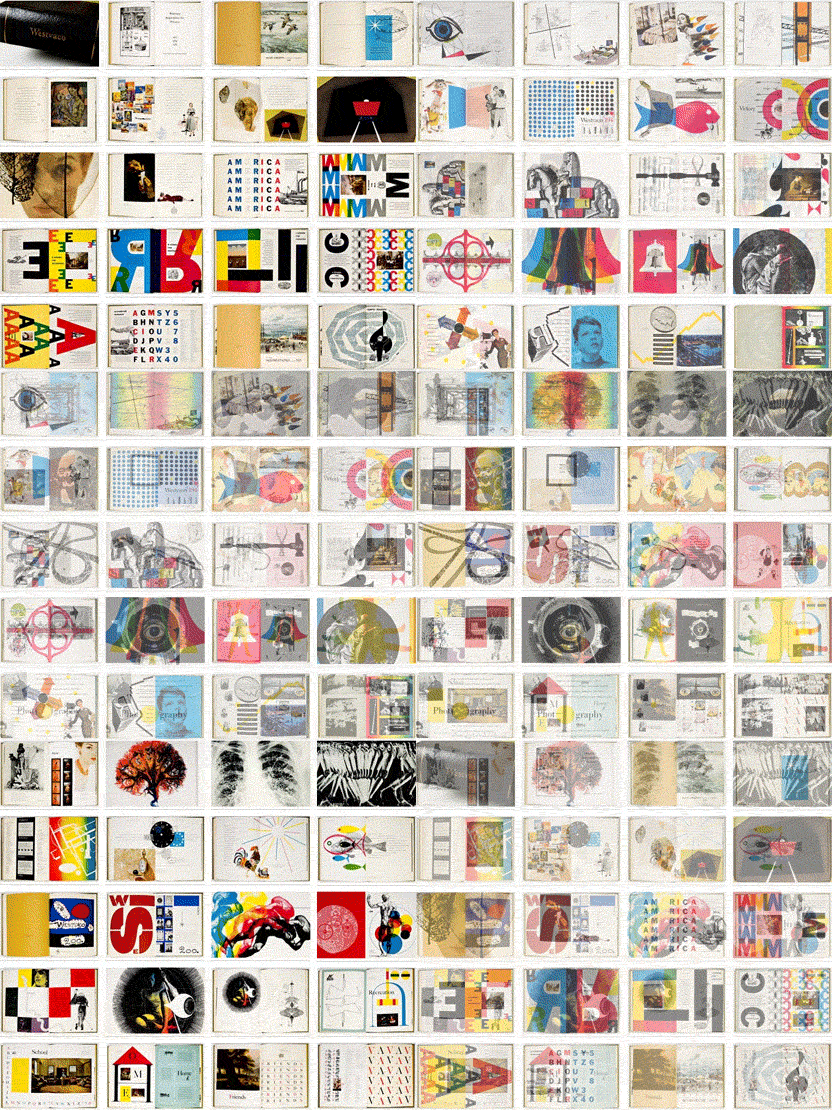
 Westvaco, a printing concern, produced a collection of books/journals, meant as inspiration for designers, printers circa 1952. Largely designed by Bradbury Thompson, they're a riot of invention, visual wit, and sophisticated cultural and art historical references.


Smart phones. One can’t imagine life without them. Ah, the endless convenience: looking up a restaurant on yelp, finding out a movie’s rating on rotten tomatoes, seeing that cute guy’s profile on Facebook. But to be honest, they’re not really that convenient. Every time you need information, you have to take out your phone, open the browser, type in a search, browse the results … after a while, even a smart phone can seem like a heavy dumb tool. Wouldn’t it be better to just look at a movie poster at the cinema and see its ratings appear next to it? When a beautiful woman talks to you at a party, wouldn’t it be great if her Facebook page with her interests and background pops up on the side too? You needn’t pine in despair: augmented reality will make these scenarios possible for you within a decade.
Augmented reality adds an information layer on top of everything in front of your eyes. How? By making you wear glasses that have tiny video cameras in them. These cameras “see” the world on your behalf and livestream it to the inside of your glasses. You feel like you’re watching the world through transparent glasses, but in fact you’re seeing a movie of the scene in front of your eyes. You could run around the whole day and never notice the difference between wearing these glasses and not wearing them: the glasses show you an exact replica of what your eyes would see. However, the advantage of having glasses is that now you can add software intelligence to them. These glasses can recognize an object in front of your eyes using image recognition software, search the Internet for information on that object and add it to the image display you see. The process of "recognize, search, add" is almost instantaneous.
One can immediately see the value of augmented content. Just imagine being a tourist in Paris and having a quick history of the Eiffel Tower displayed next to it. You’d never need holiday guidebooks like Lonely Planet again! The potential to transform the experience of education is full of promise. Instead of just reading about dinosaurs, your children could actually see small 3D dinosaurs walking on the table in front of them. But having augmented reality also has its cons. If a violent homophobe walks into a bar and his augmented reality glasses identify a person as being gay, it could become a potentially dangerous situation for that person. (To learn more about the latest augmented reality glasses priced at $2000 work, see this article and associated video on Singularity Hub)
Augmented reality adds content to a live streaming video, but it could just as easily remove content as well. This is known as diminished reality, and researchers at the Technical University of Ilmenau in Germany have developed software that can remove objects from live videos. So for example, say you had a massive fight with your ex-boyfriend and never want to see him again. You could program your glasses to remove him from your line of vision. If you walked into a restaurant where he was sitting with his new lover, the software in the glasses would remove him from the scene so that you would never know he was even there. (For technical details on how the software works, see a brief article here). Definitely watch this amazing video on how the software works.
Diminished reality can have many productive applications. Architects can imagine what a site will look like after a building has been demolished, for instance. At the same time, it can also become a destructive tool for spreading apathy in society. “I don’t want to see any homeless people on the street,” you may decide, and the software will keep deleting the poor lying on the sidewalks and you will never feel compelled to do anything about the stark income disparity in your city.
Augmented and diminished realities are going to become commonplace as image recognition becomes more sophisticated, and the circuitry and cameras become smaller and cheaper so that they can be embedded in the eye as contacts and become affordable for everyone. (See thisarticle by Babak A. Parviz whose lab at University of Washington is working on augmented reality contact lenses) These technologies can enrich our lives in a multitude of ways, but they can also forever lock each of us into an alternate reality of our own making.





 " Nalden has been filtering 'lifestyle for digital natives' since 2002. This blog works like an online desktop and includes stories supported by audio, video, snapshots and photo galleries. Some people think this blog is about trends, but it is more about curated observations.
The Industrial Revolution is often seen as a black hole in the history of typography. In that era the role of the punchcutter changed to that of a largely uncredited factory worker. Records of who worked on individual typefaces are sparse. Today it can seem as if there is practically no information left about the designers of the nineteenth century.
William E. Loy was a type vendor, printer, and writer. Loy was unhappy to see so little credit given to the designers of the types that he had spent decades using and selling. In 1896 he began work on a series of articles profiling type designers that appeared in The Inland Printer, the leading journal of the trade. Drawing on a lifetime of connections he obtained biographical information, photographs, and lists of designs to use in what he termed “sketches” about twenty-seven type designers. It was also his wish to include images of their work, but he was unable to do so for technical reasons.
Years in the business and use of firsthand sources make Loy a very credible source about the period, which spans the heyday of wood type and artistic printing. This credibility is so important because his articles identify the origins of important electrographic and pantographic techniques as well as the artistic printing movement (credited to use of John M. Wehrle’s Ornamented No. 1552, A.K.A. Ray Shaded). Loy’s biographies are brief but enlightening, examining the origins of nineteenth century American designers in England, Scotland and Germany and their subsequent immigration to the United States. The writing avoids speculation in favor of fact glazed with praise for the quality and importance of the type. Each sketch is brief, but packs a good deal of information by not dwelling on trivia.
Nineteenth Century Designers and Engravers of Type republishes Loy’s entire series of articles about America’s type designers. Editors Alastair M. Johnston and Stephen O. Saxe have furthered Loy’s work by using patent records to track down more typefaces not in Loy’s lists. Paired with the articles are images of over 800 typefaces by the designers reproduced from period specimen books. it's about 50$