this is a private blog for my design students and assorted other survivors. Tro blemakers all
this is a private blog for my design students and assorted other survivors. Tro blemakers all.

Tuesday, May 17, 2011

Il mio cari studenti , hanno una grande vacanza e
ricordare per giocare bello!


Here's another installment in the "See, nothing ever really changes"
category.


Once upon a time in Venice, we chanced upon a traditional typographer in the center of Arezzo. At 76 years old he’s been working in this same place for the past
60 years. The shop has been functioning since 1900 and much of the
original equipment and type remain there.


The poster was for a current exhibit, using old type forms and technology
that still can totally do it ! If you can identify the typeface and type style
you'll win a new Dodge Charger ! ( I don't really know what that is, nor
will you win one, whatever it may be, I think its a car...)

for ten extra points can you guess who's the cat in the hat ?


Wednesday, May 11, 2011


It's genius, Martha Graham's 117th birthday. Graham worked as an American dancer and choreographer from the 1920s up until her passing in 1991.

I suspect that she did for dance, what Matisse did for painting - as her ideas went about re-defining the form, and certainly as a result, she redirected its trajectory - away from the staid, classical cannon, common to dance at the time, towards a much more modern, immediate and and occasionaly improvised expression of movement and space.

But, ... I don't really know - what I actually know about dance - you could easily fit in the outside ring of an atom. But when I look at her work, that's been my impression.

I wonder therefore, if Ms. Graham endured the same opprobrium that Henri Matisse did ?

Matisse was
pilloried as crude, his Fauvist interpretations were not at all universally popular during his lifetime and he endured the vigorous and often unfair criticism of his contemporaries. Doesn't the photograph of Graham's dancers remind you of Matisse's drawing?

I wonder if she drew inspiration from his work ?


Wednesday, May 04, 2011

Wabi-sabi

Monday, May 02, 2011

the reason I've included this poem, which may seem totally out of context for this blog - was that I recently dreamt about a wonderful bronze statue of the author and poet John Betjeman - which was or is, in ( I think ) the Saint Pancras Train station in London.

It's a life size bronze full body portrait of the Poet, social critic, activist and art historian.

He's looking up at the sky, as if looking at a cloud, or a plane, or something off far in the distance thats caught his eye... in a kind of quizzical and relaxed manner he peers.

I remember walking by the statue in a hurry, but drawing up short and being immediately, deeply struck by the beauty of the sculpture and by the extraordinary brilliance of the sculptor. It was actually breathtaking.

He'd caught a single moment so eloquently, a man innocent and unawares, as if real, a small, normally private, incidental fragment of a life.

It was really, truly beautiful, and to my jaded, ubercooly cynical hipster mind, it was a real good lesson in just shutting up and having a look.

And so it thus occurred to me, rather sadly I must admit, that you guys would probably never ever read his poems unless forced to by a berating Englishman. That the wonderful ironic wit and genuine sadness of his words would never be noticed by you, in just the same way, that the beautiful statue had gone unnoticed by me. So I'm trying to set that right. Read it. Think of it as a coin you've found in your pocket.

It's meant to be both ironic and true at the same time, an exercise in contradiction, one rarely appreciated or even seemingly allowed these days. enjoy

Slough - by John Betjeman (1906 - 1984)

"Slough", as in now, is a ten-stanza poem by Sir John Betjeman, first published in the 1937 collection Continual Dew. It was written in protest against 850 factories that were to be built in the English town of Slough. The poem caused an uproar when first published. Slough was becoming increasingly industrial and housing conditions were truly terrible. In willing the destruction of Slough, Betjeman urges the bombs to pick out the vulgar profiteers but to spare the bald young clerks.

Slough

Come friendly bombs and fall on Slough!
It isn't fit for humans now,
There isn't grass to graze a cow.
Swarm over, Death!

Come, bombs and blow to smithereens
Those air -conditioned, bright canteens,
Tinned fruit, tinned meat, tinned milk, tinned beans,
Tinned minds, tinned breath.

Mess up the mess they call a town-
A house for ninety-seven down
And once a week a half a crown
For twenty years.

And get that man with double chin
Who'll always cheat and always win,
Who washes his repulsive skin
In women's tears:

And smash his desk of polished oak
And smash his hands so used to stroke
And stop his boring dirty joke
And make him yell.

But spare the bald young clerks who add
The profits of the stinking cad;
It's not their fault that they are mad,
They've tasted Hell.

It's not their fault they do not know
The birdsong from the radio,
It's not their fault they often go
To Maidenhead

And talk of sport and makes of cars
In various bogus-Tudor bars
And daren't look up and see the stars
But belch instead.

In labour-saving homes, with care
Their wives frizz out peroxide hair
And dry it in synthetic air
And paint their nails.

Come, friendly bombs and fall on Slough
To get it ready for the plough.
The cabbages are coming now;
The earth exhales.

In My Heart is an Idiot, filmmaker David Meiklejohn --of Portland, Maine!--follows FOUND magazine's Davy Rothbart on a North American promotional tour. Along the way, Rothbart seeks advice on his love life from various celebrities (including Zooey Deschanel and Ira Glass). I definitely recommend that you check it out!

Friday, April 22, 2011


the fascinating work of Léon Gimpel

From Wikipedia, the free encyclopedia, the Vanier students bestest friend - Léon Gimpel (13 May 1878-7 October 1948)[1] was a French photographer.

Born in Paris in 1878 , Gimpel worked for his family's fabric company, managed by his older brother Eugene. In 1897 his interest in photography was kindled when he acquired a Kodak detective camera, he soon swapped this for a Spido Gaumont which allowed him greater creative freedom.

By 1900 he was working prodigiously, documenting
the 1900 World's Fair in Paris. By 1904 his work was being published regularly in the magazines La Vie au Grand Air, La Vie Illustrée and L'Illustration.

A restless and innovative photographer, Gimpel experimented
with perspective, produced self portraits using distorting mirrors and experimented with night time photography. At an air show at Béthény in August 1909, Gimpel ascended in an air ballon to photograph the crowds below, pioneering aerial photography. However it is his pioneering work in colour photography that he is most
notable for.


In 1904, Gimpel met Auguste and Louis Lumière, who had just displayed their invention the autochrome to the Académie des Sciences. Limited by the long exposure time required, Gimpel used the process, to photograph still lifes and landscapes. Assisted by his colleague Fernand Monpillard, Gimpel modified the plates to produce "instant" colour pictures. Thanks to his works Gimpel was the only photographer who succeeded in capturing, in colour, scenes of everyday life during la Belle Époque.

On June 10, 1907 Gimpel was the first photographer to have images published in color. A special edition of L'Illustration was published to demonstrate the new technology, it included an insert featuring four autochromes taken by Gimpel, a group of soldiers, two scenic views of Villefranche-sur-Mer and sunset at Lake Geneva. A few weeks later on June 29, 1907, Gimpel published the first color news photographs when L'Illustration published his picture of Frederick VIII of Denmark and his wife Louise of Sweden, who were visiting France at the time. Gimpel produced many works using the autochrome, arguably the most famous are the images known as The Grenata Street Army produced during the First World War. Gimpel befriended a group of children from the Grenata Street neighbourhood of Paris who had established their own 'army'. Under his guidance he helped them build their tanks and aircraft, documenting their 'battles' against the Boche. On a more serious note Gimpel also recorded the French experience of the First World War visiting munitions factories and trenches on the Western Front.

Gimpel married Marguerite Bouillon in 1939 and settled in Béarn. He died in 1948 at Sérignac-Meyracq. Although largely forgotten, his work has experienced a revival recently.

The band Beirut used one of his photographs as the inspiration behind their 2007 album The Flying Club Cup. A major respective took place at Musee d'Orsay in Paris in February 2008. His work helped influence the 2009 Spike Jonze film Where the Wild Things Are.
WOWé !

Another fantastic video by Everynone in collaboration with WNYC | Radiolab.


Monday, April 18, 2011

Paper Record Player from kellianderson on Vimeo.


thanks to leplumagegris

Sunday, April 10, 2011

just watch it, it will almost fix everything, all-together too funny, enjoy ! warning extreme silliness, occasional swearing, and really really bad dancing. OH! and cowbell !

Saturday, April 09, 2011

I've been reviewing some of your mid-term magazine assignments, and I must admit they are much better than I expected at this stage. Some of them are in fact rather lovely, and demonstrate a sophisticated use of colour and interesting compositions. Johnson's layout in particular. Well done Mr.Ta ! Here are some vintage David Carson Raygun covers to inspire you, decades old, but they still walk the walk. eh ?


Cleek to make more bigs - A cool event and an opportunity
to see some interesting work by young, emerging designers
and former students. Check it out.

Wednesday, April 06, 2011


An important reminder: ! Don't Forget !

Digital 1 and 2, please remember that you must hand in at the beginning of the last class a "portfolio".

It should contain all of your work (graded or ungraded), all of the assignments for your particular class.

Such as, but not limited to: the Pollock assignment, the David Carson Project, The Blog, any/all layout typesetting assignments, le Magazine, the Sculptural letterform poster, the Street Sign assignment, the Onomatopoeia assignment, and the Film Titles assignment, etc. (note: not all projects apply to all sections, if you don't recognize a project relax.). Every section is, naturally, slightly different.

It can constitute anything you want really, the basic assignments or beyond - to infinity- it can contain a re-working or improvements of earlier projects, like the book or CD, or the product assignments or personal stuff you've done or just the assignments, as you wish.

Put your portfolio - your greatest hits, on a USB key (it will be returned next semester) or on a DVD (it will not be returned next semester), make sure that all the files are there, correctly.

If I open the portfolio and there are files missing, or fonts missing well you can guess what the result will be. Remember to always check your files on another computer, so as to ensure that it is universally openable and all the parts are there. Don't forget to " create outlines " in illustrator !

Make sure that the files are all saved as jpegs or pdf's, also ensure that you've handed in a copy, never ever hand in an original.

This is not an optional or negotiable part of the class, it is resolutely, absolute.

Due the beginning of our last class & complete. If you have questions, see me in class.
It's always about the idea, about the content. There's never really a substitute,
for it, even for things as innocuous as business cards. the cards be linked.
Thanks Qi.


Saturday, April 02, 2011

the extraordinary drawings of Cornelia Hesse-Honegger

Magazine of the Month


Underscore is created and self-published by Singapore-based design agency Hjgher. As such it is partly a show-case for the agency, but more importantly, according to editor Justin Long, it’s the magazine they felt should be out there but wasn’t.


Justin describes Underscore as ‘a magazine attuned to a simple rhythm,
quality of life’. And the physical manifestation certainly achieves quality –

this is a lovingly created, calmly paced magazine that sets it apart from
so much of todays media. The name has a double meaning – it underscores

the values it espouses but also, in a nice touch, refers to the other meaning
of the word, background music. So alongside
each issue the team prepare
a musical soundtrack to be listened while reading (available on the website
and signified alongside the related texts, below).


Book-like in design (and feel – 144pp of heavy matt paper bulk it out to

about 15mm thick), the magazine immerses the reader in a global trawl
of curiousities. Issue two (the top cover) is based on the theme ‘Constant’

while the first issue (the lower cover) was about emptiness.


Although based in Singapore the magazine has a global outlook, a quick flick yielding material about Japan, Switzerland, Berlin and Ireland. Only two issues into the project, the Hjgher team have already developed a community of like-minded collaborators around the magazine enabling the team to do things they would never have been able to achieve before launching the publication.


The colour palette, layout and typography (featuring a custom headline sans serif) are all subtle but establish a clear identity that shares some elements with Monocle in the way it refers to book design but has far more flexibility than that magazine.


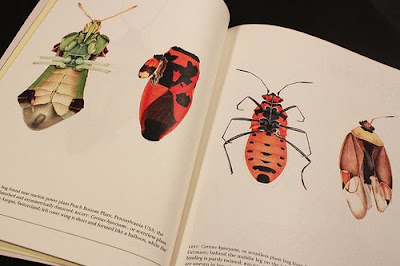
The cover of issue two and the spread above feature artist Cornelia Hesse-Honegger’s drawings of insects genetically damaged by the Chernobyl radiation. The issue also carries a pull-out print of one of the insects.

Highly recommended for its design and content, the second issue of Underscore is currentlyavailable throughout Europe, the Middle East and China, and issue three is due June this year.
HOW A MAGAZINE GETS MADE

Tuesday, March 29, 2011

Breathless 1960, Typography by Emanuel Cohen

Breathless 1960, Typography from Emanuel Cohen on Vimeo.

/ school project (université du québec à montréal, UQÀM)
/ instructor : denis dulude
Brief: Create a 30 sec. kinetic typography animation, based on a movie part, or any kind of audio recording... I chose a part from the famous French movie "À Bout De Souffle" (Breathless) by Jean-Luc Godard, 1960. In that part, Jean-Paul Belmondo is driving alone in his car, talking to the camera... In my animation, I attempted to reproduce that "in a moving car" feeling, where everything is shaky, as well as the old film look and retro animation style... Enjoy!
*Type Directors Club : TDC Intro 2010 Winning Entry.
thanx TG

Why preserve Van Gogh's palette?
dig 1 und 2 read this or I will come to your house .....

Saturday, March 26, 2011

New Work: Vignelli Gala at the Architectural League

Pentagram designed the programs for a very Vignelli evening.
On the evening of Tuesday, March 8, The Architectural League gave its President’s Medal to Lella and Massimo Vignelli. The award (past recipients of which include John D. Rockefeller, Jr., Hugh Ferriss, Joseph Urban, Richard Meier, Robert A.M. Stern, and Robert Venturi and Denise Scott Brown) was given to the Vignellis “in recognition of a body of work so influential in its breadth that it has shaped the very way we see the world.” The setting was a gala evening in midtown Manhattan attended by nearly 300 colleagues, friends and admirers of the guests of honor. Pentagram’s Michael Bierut, an Architectural League vice president who began his career over 30 years ago as a junior designer at Vignelli Associates, designed the evening’s program. With five different covers featuring five different classic Vignelli quotes (in Helvetica, of course) printed in PMS Super Warm Red (the couple’s favorite color), the programs were the perfect table settings for a memorable evening.


Pino is a market place for unique, functional and innovative design objects. The idea for the concept camefrom the name of the shop, Pino, which means a ‘pile’ or ‘stack’ in Finnish.That is taken visually into the new logo and the design of the shop fixtures.The interior concept with a subtle colour palette works as a background for thefresh, colourful identity and products.

Thursday, March 24, 2011


Marcel Marien, L'introuvable, 1937 dav.

Wednesday, March 23, 2011

sculpture as fashion, the brilliant work of

Mary Katrantzou at London Fashion Week
Young designer Mary Katrantzou first standalone show
at London Fashion Week was stunning. The collection
was inspired by the stylized 70s photography of Helmut
Newton and Guy Bourdin, where the interiors became
as important as the models. Each garment was a work
of art; the patterns were inspired by old copies of
Architectural Digest and World of Interiors. Delicate
silk blouses were tucked into mini-crinolines imitating
lampshades while dresses with prints of window frames
had chiffon fluttering like drapes.

" With this collection, I wanted to put the room on the woman,
rather than the woman in the room."

---Mary Katrantzou


Monday, March 21, 2011

I have a query - that maybe one of you monsters can answer.

I've noticed that typesetting or type set in different browsers can appear differently in various browsers. In other words ( I hate doing that ) what appears to be well set, balanced, correctly leaded and kerned etc. in one browser, goes all screwy in an other.

The recent post regarding the football supporters graphic/map is a good example, in Safari it looks fine but in FireFox it looks as if typeset by a marmot. Any ideas ? Is there a universal typsetting method which is browser agnostic, and will work in all browsers, regardless of it's origin ? Or is that just ridiculous ? , an impossible thing to ask for - continuity .....

Sunday, March 20, 2011

Thursday, March 17, 2011

digital 2, vis a vis your product assignment - remember that
design isn't decoration, anymore than dj's are musicians ...

Tuesday, March 15, 2011


" Football isn't a matter of life and death," - it’s much more
important than that,” is a quote often attributed to Bill Shankly, the
legendary manager
of Liverpool FC.
As exaggerations go, this one gets
pretty close to the truth. Millions of fans identify intensely with the highs
and lows of their favourite
sports team, perhaps a modern substitute for
the tribal loyalties of bygone days.

Fandom is a bit more complicated than mere tribalism, though. Which
team you support is the result of an intricate compound of ancestral,
regional, social, and sometimes even religious loyalties. And, of course,
personal choice. However, this map of London seems to indicate that
geography is a major factor in fan loyalty.

check out
Frank Jacobs's facinating site, concerned with informatics

design and all manner of strange and wonderful maps that you might
imagine.